


“Earth laughs in flowers”
Ralph Waldo Emerson in Hamatreya
It is cherry blossom season in Tokyo right now, and Elizabeth is there doing an interview for a future podcast. The crew has been sharing photos of the cherry trees and indeed, they appear to be welcoming spring with joy and laughter.
When Elizabeth asked me to write this issue of our newsletter to launch our April podcast in honor of Earth Day, the Emerson quote naturally came to mind. While poets freely anthropomorphize, science writers walk a fine line to explain more-than-human behavior.
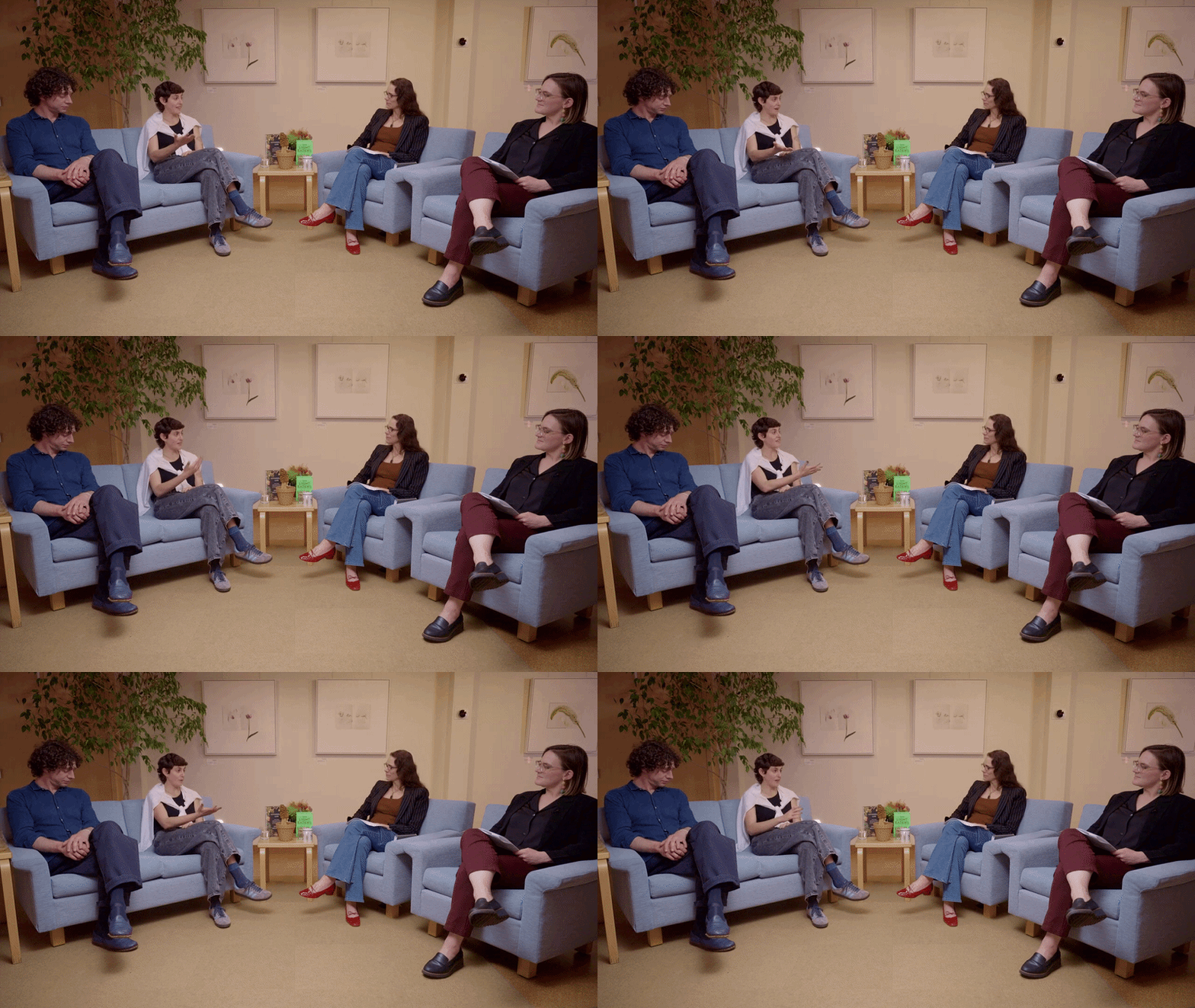
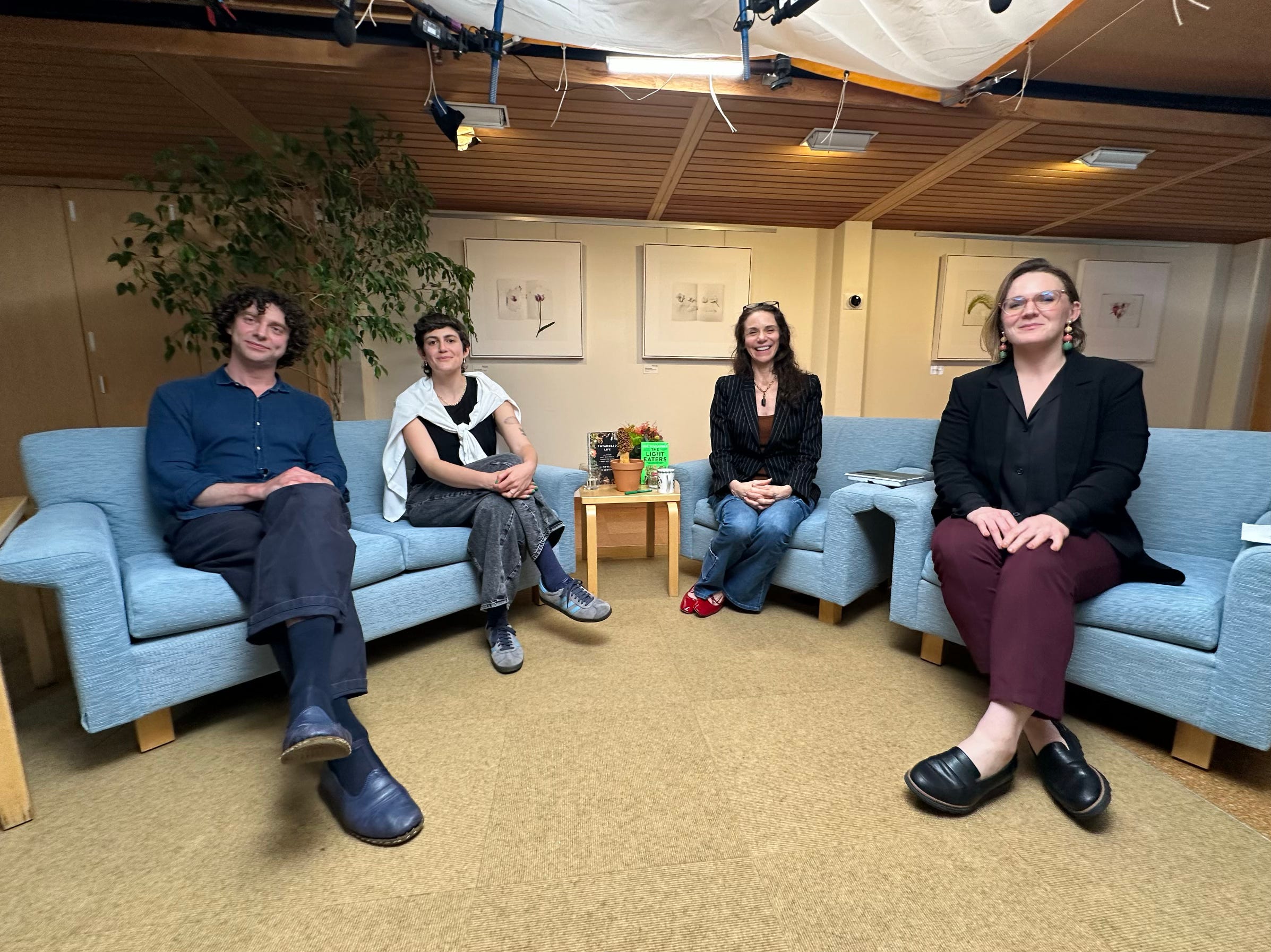
The guests on our podcast, Zoë Schlanger, author of The Light Eaters, and Merlin Sheldrake, author of Entangled Life, are gifted storytellers who write about the connections between people, plants and fungi in a way that enchants readers from all walks of life. Their best-selling books are respected by scientists and beloved by nature enthusiasts. Co-hosting with Elizabeth is Rachael Petersen, a former environmental policy specialist and organizer of Harvard Divinity School’s “Thinking with Plants and Fungi Conference” where the conversation was recorded.
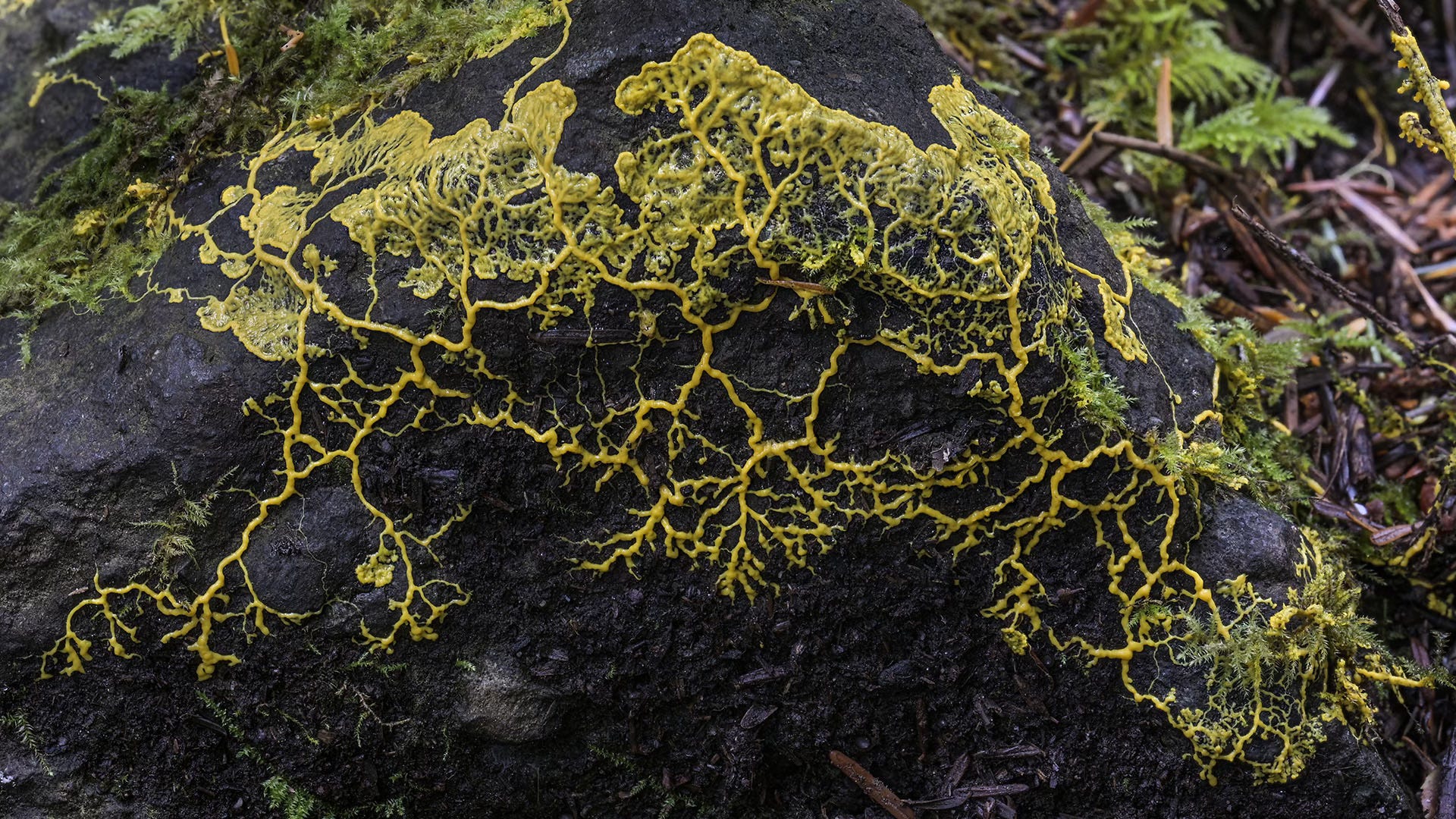
As the title of the conference suggests, it was a meeting of minds around recent discoveries in plant and fungi research. Evidence of problem-solving, memory, kin recognition, and other surprising behaviors set the stage for both intrigue and debate. Elizabeth recalls a session on the Boquila plant with a brilliant capacity to mimic nearby plants to evade herbivores. Merlin tells about a slime mold that could find its way out of an IKEA faster than we can. It has no brain or legs; it’s just a yellow blob that pulsates along the shortest path through mazes. Zoë shares news about fern sperm that swims through rainwater to procreate, unless a rival fern deliberately releases a killer chemical to sabotage the tryst.
The question is, do stories like these lead people to use metaphorical language like the “intelligence” and “consciousness” of plants, mold and fungi? And is that such a bad thing? Elizabeth gets right to the heart of the matter when she asks, “Does it make me an animist if I feel like the world is alive?”
The wonder and curiosity of children may make them “innate animists” suggests Zoë. A healthful aspect of writing her book was connecting to the childhood version of herself who grew up with a family of ducks in her backyard. She sensed that they too had a desire to live with each other and have a social life. As grown-ups, perhaps we become estranged from the natural environment, and we forget how to be in relationship with other life forms.
Our “illusion of connectedness” through digital devices is part of the problem, according to Merlin. But he also sees an “ecological” turn toward the origin of the word, oikos, which means home or household. It has to do with where we live and who we live with. It’s the “we” that can make us rethink our “family” in a larger sense. A deep desire to connect with something greater than ourselves can inspire us to forge “partnerships” with all life on Earth. For instance, it may be possible that “we” could tackle the climate crisis by collaborating with non-human organisms to identify solutions with biocomputing.
Rachael picked up on the way the authors played with new ideas and asked them about it. For Zoë, open-plan awareness and numinous experiences during play are the roots of discovery in science and creativity in art. A playful attitude not only staved off boredom for Merlin, it also allowed him to imagine what fun would look like to the organisms he was studying. Sometimes non-survival functions morph into new characteristics; could that be a kind of metabolic play?
These are just a few reflections from a fascinating discussion. Tune in to the podcast for insights about “The Last of Us,” AI, plant personalities, wacky forms of fermentation and more, from our co-hosts and guests.
Then we invite you to take a walk outside and notice how your experience of the living world has shifted. Whether you find yourself beneath a canopy of blossoming trees, passing a well-tended garden, or stepping along a sidewalk where dandelions push up through broken concrete - can you witness, in your own way, how the Earth laughs in flowers?

Watch Wonderstruck on YouTube and subscribe on Apple Podcasts, Spotify or wherever you get your podcasts. Don’t forget to follow us on Instagram, TikTok and Facebook for the latest clips and news.
Did You Know?
✦ Both Zoë Schlanger and Merlin Sheldrake, along with Emerson and Thoreau, were inspired by Alexander von Humboldt, the 19th-century naturalist who described nature as a “web” in which “no single fact can be considered in isolation.” In his biography The Invention of Nature, author Andrea Wulf reveals that Humboldt brought together science, a sense of wonder, and the belief that “we will only protect what we love,” some of the prevailing ideas behind the celebration of Earth Day, which will take place on April 22, 2026.
✦ “Earth laughs in flowers” is a line from “Hamatreya,” an 1846 Emerson poem about human landowners’ illusion that they “possess” the land but ultimately return to the soil. The title is Emerson’s adaptation from the Vishnu Purana: Maitreya is a disciple who hears a chanted “song of the Earth” about kings who thought they owned the world, and some scholars read “Hamatreya” as Emerson’s hybrid form of “Hail, Maitreya” or an address to Maitreya.
✦ Gustav Fechner’s Nanna, or On the Soul-Life of Plants, is one of the most unusual books in the history of science. Named after Nanna, the Norse goddess of flowers, it argued that plants possess souls and an inner life. It combines rigorous empirical observation with a mystical conviction that the living world is animated from within. Rachael Petersen wrote her doctoral dissertation on Nanna, translating it into English and exploring how Fechner’s combination of science and metaphysics might have relevance today.
