


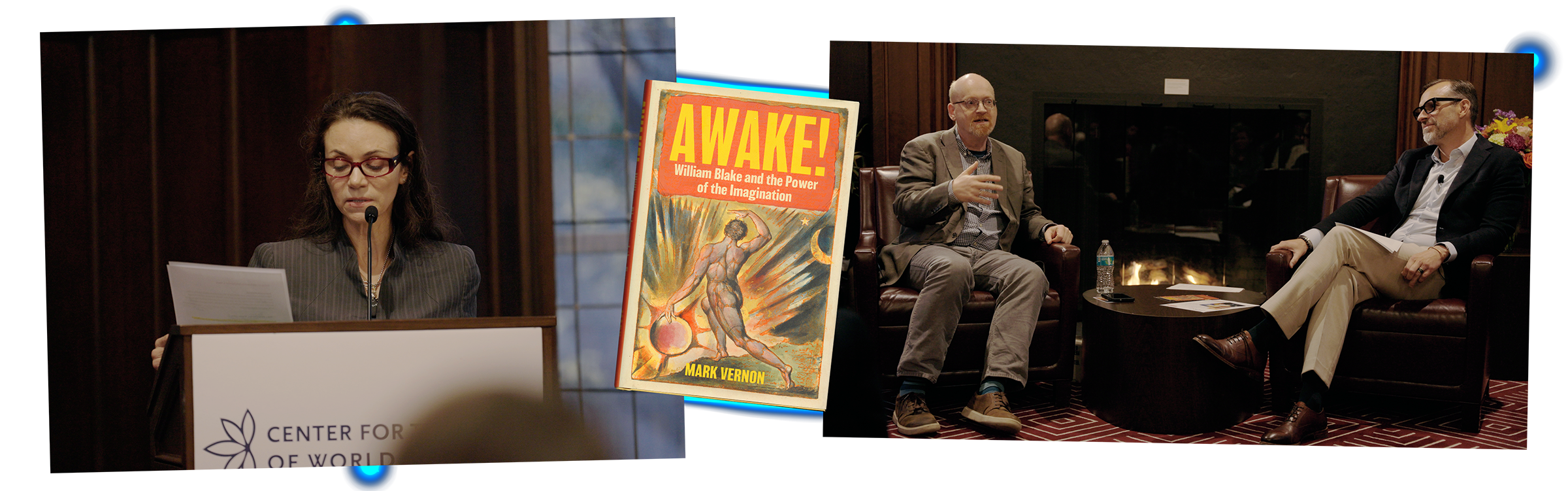
My friend and co-worker Donna Mackay is writing the introduction for my interview with Mark Vernon. Actually, we have two delightful Mark Vernon recordings this month, our podcast episode and an event with the CSWR (Center for the Study of World Religions) at Harvard Divinity School just this past week. I managed to do a short contemplative reading and Charles Stang interviewed Mark about his new book, Awake! William Blake and the Power of the Imagination.
I say ‘managed’ because I’ve got a concussion. I’m not cleared yet to be working, so just like my reading, this note will be short. I was hit accidentally by a Yeti water bottle. The official diagnosis according to the neurologist who sees this injury frequently with seventh graders at bat mitzvahs is “being yettied”.
I had hoped for the bonk on the head to open the Blakean doors of perception…but this has yet to happen.
The silver lining has been a deeper engagement with the imagination: drawing, meditating, spending more time in nature, which is lovely on the one hand, and on the other, sometimes it’s rough going. Back on board soon, and now to Donna…
— Elizabeth

Elizabeth’s reflection on her injury and the silver lining she’s finding in a restorative
pause offers profound context for our conversation about making sense of adversity. Philosopher, psychotherapist, and prolific writer Mark Vernon blends the authority of a scholar with the wisdom of a sage to guide people from confusion to clarity. That’s what Elizabeth set out to explore with him in our podcast.
As the search for meaning grows more urgent in a world of constant change, Mark reframes the crisis. The problem isn’t a lack of meaning; there is an overload of competing messages in a “horizontal flatland” of countless therapies. What’s missing is the vertical dimension of life, the transcendent axis that orients the soul and gives depth to experience.
It can be difficult to speak of the soul in a secular setting like a therapist’s office. So Mark turns to The Cloud of Unknowing, a medieval text on surrender. When clients reach aporia, Plato’s word for descent into despair, suffering becomes intelligible and necessary for transformation.
The conversation turns to whether this soul work is possible for those averse to religion or the symbol of the cross because of guilt. Mark points to the Greek Orthodox tradition, where the cross is not a ledger of debt but a pattern of theosis, dying to self for a rebirth of spirit.
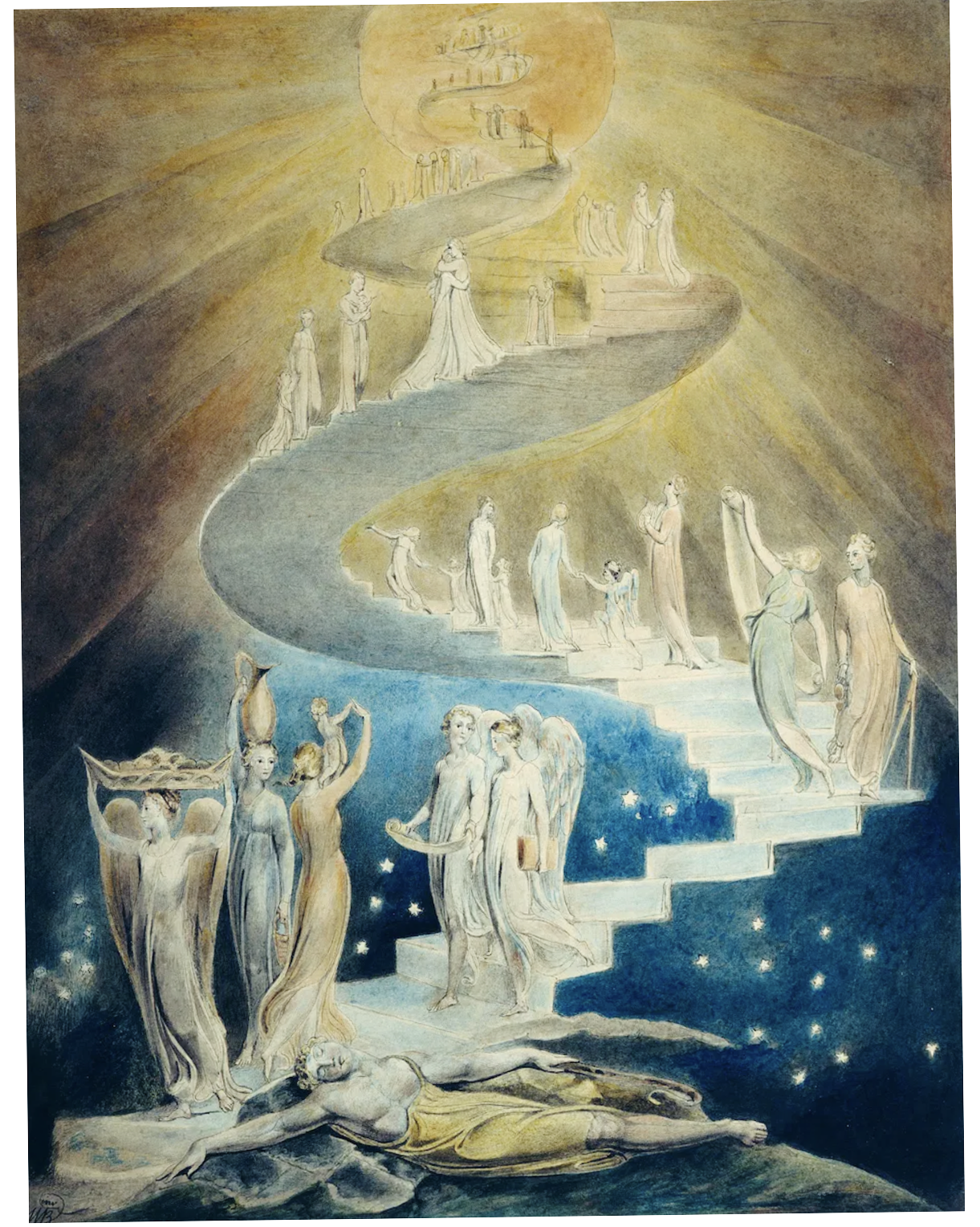
Here we encounter paradox and polarity—descending to ascend, dying to live, releasing to receive—as themes that teach humility in literature, parables, and religion. Meanings shift, but our longing for divinity endures. Any path that suppresses the soul leads us astray.
Listening to Mark, it felt as though mystics, philosophers, and poets across centuries were tending to Elizabeth’s questions, inviting us to see pain as passage and surrender as grace. In crisis, Rumi’s words about love turning pain into medicine come to mind. What could be more liberating than realizing meaning abides in our own hearts when we open to the sacredness of life?
In this episode, we discuss:
✦ The overwhelm of conflicting meanings and remembering the sacred
✦ The spiritual thread connecting Dante, William Blake, and Jesus
✦ How wonder helps us access the divine
✦ Why psychotherapy is a path for ‘spiritual intelligence’
Mark’s work invites us into the depths of wonder and spirituality as a necessity for the soul. We’d love to know your thoughts on the episode.
Drop us a comment on YouTube, Spotify, Instagram or here on Substack. Thanks for listening with us.
We also recorded the special event that we co-hosted with CSWR at Harvard Divinity School, where Mark Vernon, Harvard scholar Charles Stang, and Wonderstruck’s Elizabeth Rovere explore how William Blake saw imagination not as a talent of the isolated mind, but as the living, divine presence in which we already exist.
Blake saw exactly the same as everybody else, but he saw more of it. This conversation invites us to see more as well, and to rediscover what Blake knew: that everything, when rightly perceived, is infinite.
DID YOU KNOW… Sudden Savant Syndrome is a rare phenomenon in which a traumatic brain injury unexpectedly unlocks extraordinary abilities…mathematical genius, musical mastery, or fluency in a new language…as if a hidden chamber of the mind has been flung open. As Mark Vernon explains, through “different kinds of death…more life is found.” Under certain forms of rupture, the psyche can access capacities that feel uncanny, latent, or otherworldly.
DID YOU KNOW… Jim Morrison naming his band The Doors ties back to when William Blake coined “the doors of perception” in his 1790 work The Marriage of Heaven and Hell? He wrote “If the doors of perception were cleansed every thing would appear to man as it is, infinite.” Aldous Huxley borrowed Blake’s phrase to title his 1954 mescaline memoir The Doors of Perception, which inspired Morrison in 1965… and well, the rest is history.

Join us at Wonderstruck, where bewilderment becomes belonging and awe might just change the way we see.